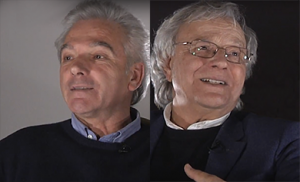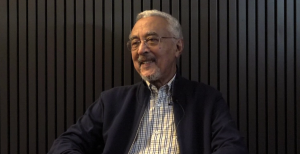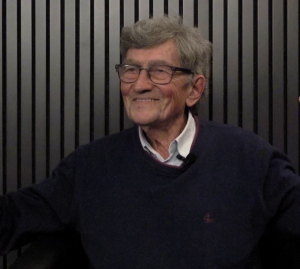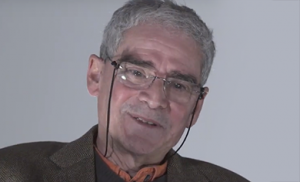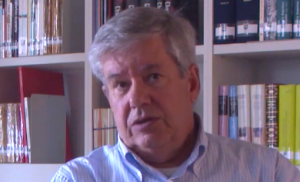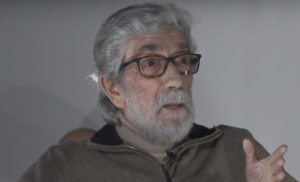
António Borges Coelho and Jorge Tavares da Silva
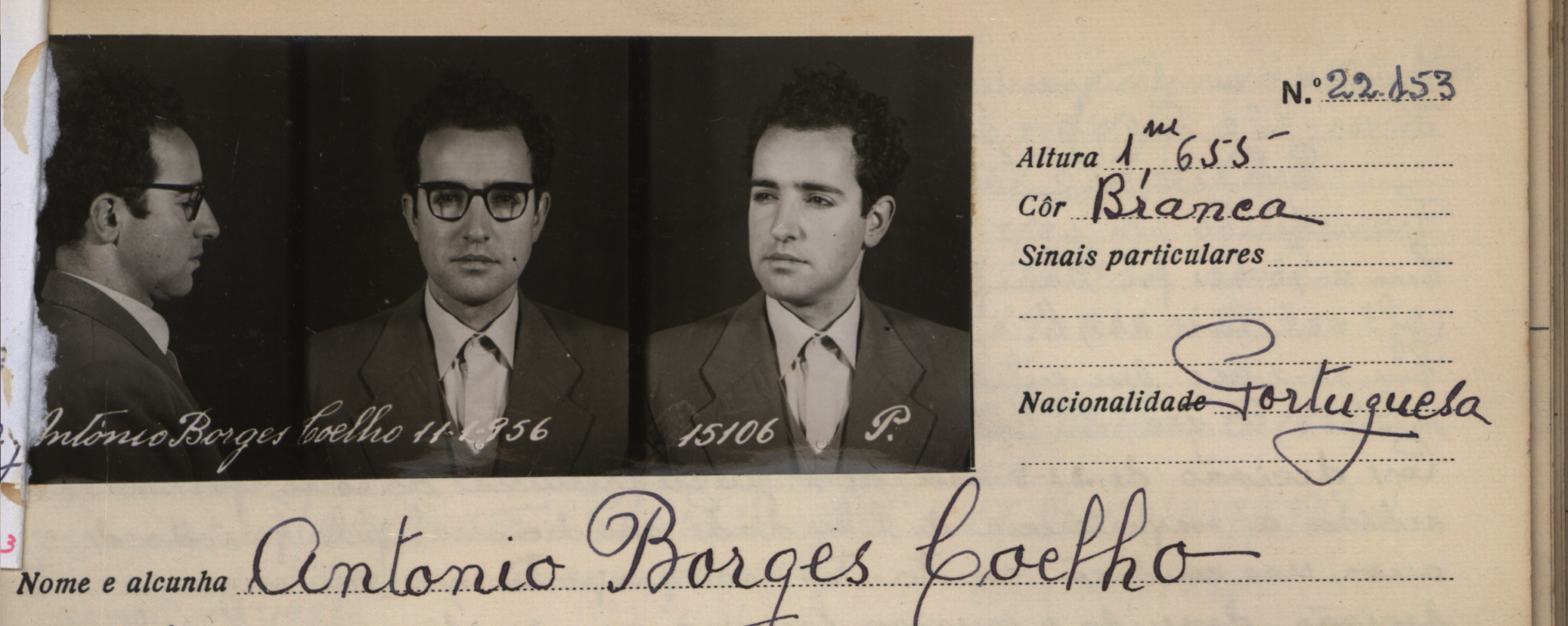
António Borges Coelho was born in Murça (Vila Real) on October 7, 1928. Determined to become a Franciscan friar, he entered the seminary, from which he was eventually expelled.
In the late 1940s, he entered the Faculty of Law in Lisbon, but abandoned his studies to dedicate himself exclusively to politics. In 1949, he joined the Youth Democratic Unity Movement (MUD) and, later, the Portuguese Communist Party (PCP). On January 3, 1956, already an underground PCP leader, he was arrested by the PIDE (Instituto Nacional de Desportivo de Deportes) and sent to the Aljube prison. He was then sent to Caxias and the PIDE delegation in Porto. Tried in June 1957, sentenced to two years and nine months in prison, he was transferred to Peniche prison, and after his sentence was completed, he was placed under security measures. While imprisoned in Peniche, he married Isaura Silva in 1959. A year later, Borges Coelho chose not to join the escape from Peniche of several PCP leaders. He refused to go into hiding again and intended to pursue a career as a historian after his release. However, he was punished and sent to Aljube, where he was subjected to torture by the statue and six months of solitary confinement. Returning to Peniche, he dedicated himself to historical writing. In 1962, he was granted parole for a period of five years. In 1967, he completed his degree in Historical-Philosophical Sciences at the University of Lisbon. In 1968, he became a journalist at A Capital. He also worked for Diário de Lisboa, Diário Popular, Vértice, and Seara Nova. A retired professor at the Faculty of Arts of the University of Lisbon, he has published works such as The Roots of Portuguese Expansion, The Revolution of 1383, Questioning History, The Inquisition in Évora (1987), and several volumes on the History of Portugal.
A founding member of the Civic Movement “Don’t Erase Memory” (NAM), he was president of the Advisory Board of the Aljube Museum until 2020, with which he has collaborated since its inception. In 1999, he was awarded the Grand Cross of the Military Order of Santiago da Espada, in 2018 the Grand Cross of the Order of Liberty, and in 2019 the Government awarded him the Medal of Cultural Merit.
Jorge Tavares da Silva was born in Amadora on June 19, 1945. Coming from an economically privileged family background, his awareness of injustice, inequality, and poverty led him to political action. From a young age, he became involved in the fight against the dictatorship and realized that it would only fall by force.
After joining the Popular Action Front (FAP), he was arrested on February 27, 1965, and imprisoned in the Aljube “curros” (curries). He was subjected to sleep torture and isolation. Arrested in Caxias, he was sentenced in February 1966, in a plenary court, to 17 months of correctional imprisonment. On April 6, he was transferred to Peniche prison, from where he was released in July. This was followed by military service in the 1st Disciplinary Company of Penamacor, and, determined not to fight in the colonial war, he deserted in October 1967. He left the country in a hurry and went to Belgium. His choice of destination was largely due to his ideological affinity with Jacques Grippa’s pro-Chinese Belgian party. In Brussels, he obtained refugee status, remaining there until after the April 25 revolution.
Jorge Tavares da Silva’s life ended on December 29, 2016, and his ashes were scattered in the gardens of the Uccle crematorium in Belgium.
Date of Collection: 21.10.2015
Keywords: Aljube Prison, PIDE, Interrogation, Torture, Escape from Peniche, Caxias, Family, Colonial War, Exile, Penamacor Prison.