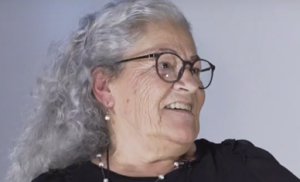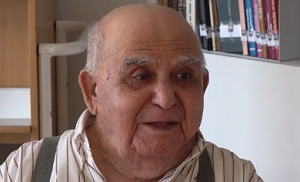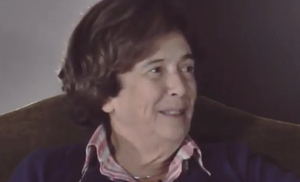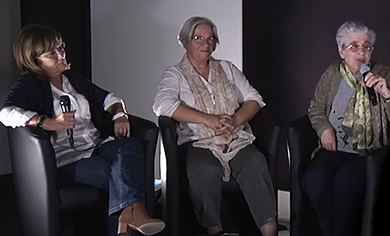
Eulália Miranda, Hermínia Vicente and Maria Lourença Cabecinha
Biographies
Eulália Rosa Caeiro Miranda was born in Montoito, Redondo (Évora), on May 29, 1954, to Dinis Miranda and Elidia Rosa Caeiro, both clandestine employees of the Portuguese Communist Party (PCP) and political prisoners. Due to her parents’ clandestine activities, Eulália lived with her grandparents. Except for visits in prison, she would only see her father again after his release from Peniche following the April 25th Revolution.
At a very young age, Eulália became involved in the fight against the dictatorship, notably within the Workers’ Youth Movement, the PCP, and the Democratic Electoral Commission (CDE). She participated in various actions against the colonial war, workers’ struggles, and the 1973 election campaign.
After the April 25th Revolution, 1974, she became a member of the PCP and, between 1983 and 2004, served on the party’s Central Committee. A textile worker, she was a union delegate at Melka, a member of the Évora District Committee, and the Executive Board of the Alentejo Regional Directorate. She was involved with the Women’s Democratic Movement (MDM) and was a leader of the Portuguese Anti-Fascist Resistance Union (URAP).
Hermínia Vicente was born on March 5, 1953, in Casebres, Alcácer do Sal, in a 35-square-meter house with a dirt floor. The daughter of rural workers, she began working in the fields at age 11, completing only the 4th grade.
The exploitative conditions, low wages, and long working hours accelerated her political awareness and fueled a strong sense of rebellion. She married at 15, and her first daughter was born at 16.
During the revolutionary process of 1974 and 1975, she actively participated in the Agrarian Reform and joined the Portuguese Communist Party (PCP). She led the group of women who took over the farm where they worked and joined the newly established Cooperative of Sheds. In 1982, she served as a councilor on the Alcácer do Sal City Council for the United People’s Alliance (APU).
Maria Lourença Calção Cabecinha was born on March 17, 1933, in São Romão, Montemor-o-Novo, the daughter of rural workers. Her father was arrested in 1949. She began working in the fields at age 12. In 1948, at age 15, she joined the Portuguese Communist Party (PCP). She became a civil servant in 1952, when she moved in with Antonio Gervásio and their three-month-old son, who, at age three, was handed over to his maternal and paternal grandparents. After her husband’s arrest in 1963, Maria Lourença Cabecinha remained in hiding. She was arrested in July 1964. In the Caxias prison, she was subjected to painful interrogations, psychological torture, lack of medical care, and discrimination, but she was never tortured. While in prison, she studied Portuguese and French with Fernanda Paiva Tomás, mathematics and geography with Alda Nogueira, and acquired knowledge of hygiene, health, and maternal and child care with Julieta Gandra. Sentenced in January 1965 to two years and ten months in prison and security measures, which began in 1967. Released in September 1969, she returned to hiding in July 1970, remaining in that situation until May 28, 1974.
Upon release, she held various party responsibilities and was active in the Portuguese Anti-Fascist Resistance Union (URAP) and the Women’s Democratic Movement (MDM).
Date of Collection: 19.10.2016
Keywords: Peasants, Women, Fight of 8 hours of work, Family, Children of Clandestine, Comunist Party, Workers, Underground, Prison, Interrogations, Caxias, CDE, April 25th.